Two Americas: How the Founders Fought Over the Soul of the Nation
- Melissa Goldin
- Sep 19, 2025
- 6 min read

When I began this project, I only had a hunch, something like a “Spidey sense” that America’s obsession with work, worth, and judgment came from our Puritan past. The more I dug, the more I realized I wasn’t the first to sense it. Over a century ago, the sociologist Max Weber argued that Calvinist theology had left us with “the spirit of capitalism,” where endless labor became a moral duty.
Weber’s warning was stark:
“The Puritan wanted to work in a calling; we are forced to do so.”
What he meant was that Calvinists originally worked as a way of showing faith and discipline. But later, that sense of duty was stripped of its religious roots and hardened into an economic compulsion. Labor was no longer a choice — it became an obligation.
I am not trying to repackage Weber. Later scholars like Sacvan Bercovitch, who traced the Puritan “American jeremiad,” and critics of modern capitalism have shown how this inheritance kept mutating. What I want to do here is explore how the Founders themselves stood at a crossroads between two competing inheritances: the Enlightenment, with its ideals of liberty and reason, and Puritanism, with its moral strictures and vision of chosenness. America’s “two souls” were already present at the beginning.
Enlightenment Confidence
The Revolution was framed in the language of the Enlightenment — an intellectual movement that prized reason, science, and universal human rights over inherited authority and rigid theology. Thomas Jefferson and Benjamin Franklin were among the clearest voices of this new order.
Jefferson’s Declaration of Independence rooted legitimacy in the consent of the governed, not the judgment of God. His famous line that “all men are created equal” expressed a universal principle, even if his own life fell painfully short of it.
Jefferson also rejected Calvinism outright. In an 1813 letter to John Adams, he did not mince words:
“His [Calvin’s] religion was demonism. If ever man worshiped a false God, he did. … the five points of Calvin … a demon of malignant spirit.”
Franklin, too, turned away from Calvinist strictures. He recalled that as a young man he “soon became a thorough Deist” after reading anti-Deist tracts that accidentally persuaded him. Deism’s faith in reason and natural law left no room for predestination.
For Jefferson and Franklin, America was a chance to build a society guided by intellect, science, and rights rather than inherited theology.
Puritan Shadows
But the Puritan inheritance was not erased. John Adams, though not a Calvinist himself, still sounded the old notes. In 1798, he wrote:
“Our Constitution was made only for a moral and religious people. It is wholly inadequate to the government of any other.”
Adams feared that liberty without discipline would collapse into chaos. Many clergy who backed independence preached it as a divine mission, insisting America was “chosen” for a special role. This idea of chosenness — a secularized version of being among “the elect” — proved remarkably durable.
Here, it's important to be precise. Puritan theology in its original context was about small communities holding one another accountable in covenant. But as America grew and industrialized, that moral logic was secularized. Max Weber observed the shift clearly:
“The Puritan wanted to work in a calling; we are forced to do so.”
What began as a spiritual discipline became an economic compulsion. The logic of work-as-virtue and leisure-as-suspect outlived Calvinism itself. Industrialists wrapped their business models in this moral language even if they never named its religious roots. John D. Rockefeller could say, “God gave me my money.” Henry Ford declared, “There is joy in work. There is no happiness except in the realization that we have accomplished something.” Andrew Carnegie, in his Gospel of Wealth, called accumulation and philanthropy moral obligations.
None of these men quoted Calvin, but their moral vocabulary echoed Puritan patterns: success as providence, labor as duty, suffering as proof of virtue. These were cultural mutations of Calvinism, bent to fit the needs of capitalism. The theology had shifted, but the logic endured.
A Constitution of Compromise
The Constitution reflects both inheritances. On the one hand, it is deliberately secular, forbidding religious tests for office and protecting freedom of worship. On the other, it assumes a virtuous citizenry capable of restraint.
James Madison tried to navigate this tension. In Federalist No. 51, he wrote:
“If men were angels, no government would be necessary. … In framing a government which is to be administered by men over men, the great difficulty lies in this: you must first enable the government to control the governed; and in the next place oblige it to control itself.”
That statement reflects Enlightenment rationalism, but it also echoes the Puritan view of human nature as deeply flawed. Madison’s checks and balances were constitutional safeguards against both tyranny and sin.
The Two Americas in Conflict
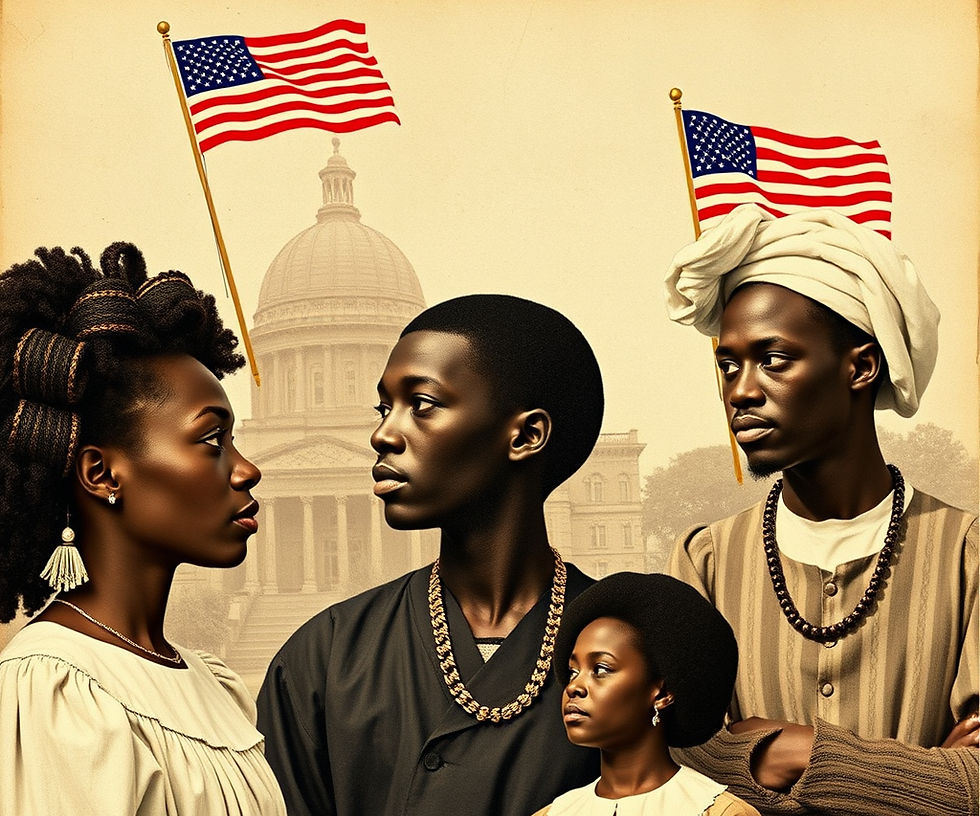
From the beginning, these two inheritances collided in practice. Debates over slavery exposed the fracture lines. Jefferson’s words about equality rang hollow in a society that enslaved millions. Southern leaders bent religious and moral language to defend bondage, claiming divine sanction for a system that treated people as property. In the North, Enlightenment ideals fueled early abolitionism, though even there Calvinist moralism often framed freedom as conditional on piety and obedience.
Class divisions sharpened too. The Puritan logic that suffering proved virtue was easily adopted by elites who wanted to discipline the poor. Work was moralized, leisure was suspect, and laborers who resisted were branded as weak or sinful. Race and class together meant that freedom was never truly universal: it was rationed, justified, and withheld through theological and moral arguments that benefited those in power.
The Echoes Today
We still live with this tension. Debates about whether America is a secular republic or a chosen nation run through our politics, our schools, and even our courts. Arguments about who counts as “deserving” - of aid, of rights, of rest - are echoes of this old struggle.
But history shows which side has often carried the louder voice. The Puritan legacy, twisted by capitalism, still whispers that worth must be earned and that leisure is suspect. As Weber put it, what began as a calling has become a compulsion.
That imbalance matters. Because the United States was built with both legacies in tension, the Puritan shadow keeps reasserting itself, pushing Americans to tie identity to productivity and morality to control. If America sometimes feels divided against itself, that is because it was born divided, and the side that demanded endless work and vigilance has too often won.
In the battle for America’s soul, the past proved harder to escape than anyone expected. And until we reckon with how much of that past still drives us, we will remain haunted by a Puritan inheritance that mistakes suffering for virtue and labor for worth.
Bibliography
Adams, John. Message to the Officers of the First Brigade of the Third Division of the Militia of Massachusetts. October 11, 1798. In The Works of John Adams, Second President of the United States, edited by Charles Francis Adams, Vol. 9. Boston: Little, Brown, 1854.
Bercovitch, Sacvan. The American Jeremiad. Madison: University of Wisconsin Press, 1978.
Carnegie, Andrew. The Gospel of Wealth. North American Review 148, no. 391 (June 1889): 653–664.
Ford, Henry. My Life and Work. Garden City, NY: Garden City Publishing, 1922.
Franklin, Benjamin. The Autobiography of Benjamin Franklin. Edited by Leonard W. Labaree et al. New Haven: Yale University Press, 1964.
Gorski, Philip S. The Disciplinary Revolution: Calvinism and the Rise of the State in Early Modern Europe. Chicago: University of Chicago Press, 2003.
Jefferson, Thomas. The Papers of Thomas Jefferson, edited by Barbara B. Oberg et al. Princeton: Princeton University Press, 1950–.
Jefferson, Thomas, to John Adams. January 24, 1814. In The Adams–Jefferson Letters: The Complete Correspondence Between Thomas Jefferson and Abigail and John Adams, edited by Lester J. Cappon. Chapel Hill: University of North Carolina Press, 1959.
Madison, James. Federalist No. 51. In The Federalist Papers, edited by Clinton Rossiter. New York: New American Library, 1961.
Rockefeller, John D. Random Reminiscences of Men and Events. New York: Doubleday, Page & Co., 1909.
Tawney, R. H. Religion and the Rise of Capitalism. London: John Murray, 1926.
Weber, Max. The Protestant Ethic and the Spirit of Capitalism. Translated by Talcott Parsons. New York: Charles Scribner’s Sons, 1930.


Comments